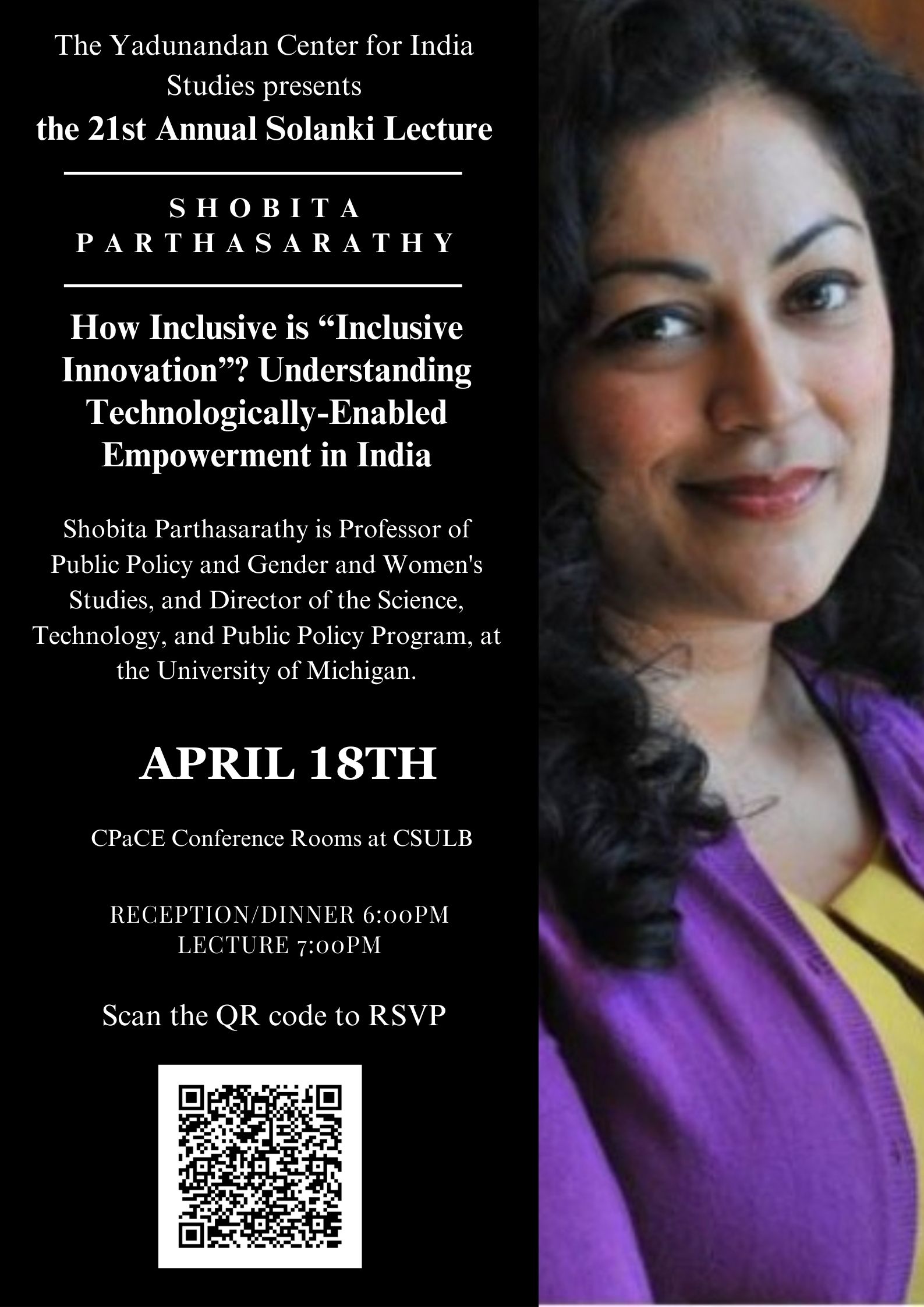
2024 Annual Solanki Lecture: How Inclusive is “Inclusive Innovation”?
Parking:
If you need parking (for off campus visitors), please follow the directions below.
We have reserved spots for you in the Research Foundation Parking Lot, which is across the street and half a block east from the lecture venue. There is also a campus map (where the lecture venue and the parking lot are circled) and directions to the campus attached to this note.
Once you arrive at the Research Foundation parking lot, please use the CENTER LANE pull up to the automated kiosk in visitor entrance (again, please use the CENTER LANE) and do the following when you arrive at the kiosk:
1. Press “D” (right side of screen) to enter code.
2. Enter code 6944201 using keyboard numbers (below screen).
3. Press “D” (right side of screen) to open gate.
4. Pull into lot and walk to the venue.
A Conversation with Aamina Ahmad
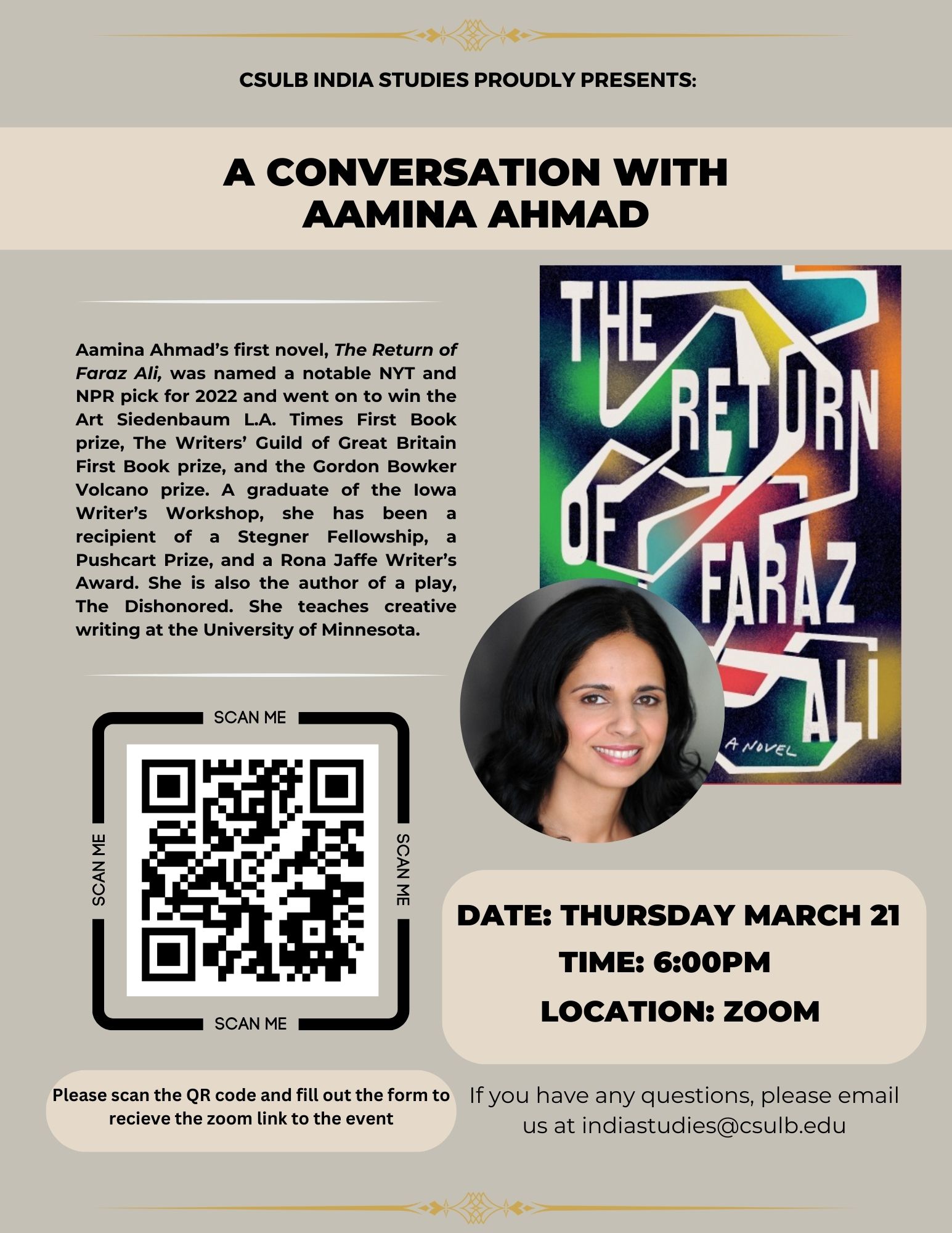
The Yadunandan Center for India Studies at Cal State Long Beach is proud to present:A Conversation with Aamina AhmadAamina Ahmad’s first novel, The Return of Faraz Ali, was named a notable New York Times and National Public Radio pick for 2023 and went on to win the Art Siedenbaum Los Angeles Times First Book Prize, The Writers’ Guild of Great Britain First Book Prize, and the Gordon Bowker Volcano Prize.Aamina Ahmad is a graduate of the Iowa Writer’s Workshop, she has been a recipient of a Stegner Fellowship, a Pushcart Prize, and a Rona Jaffe Writer’s Award. She is also the author of a play, The Dishonored. She teaches creative writing at the University of Minnesota.The event will take place on Zoom on March 21st at 6:00PM
To RSVP, please scan the code on the poster below. When you do, we will send you the Zoom information and a reminder.
Rousing A Nation Across Nations: Embodied Protests and Tibetan National Mobilization
Tsewang Dolma, a Tibetan refugee, stood unwavering in her commitment to the hunger strike unto death during the 2015 campaign in Delhi, India. Despite the ensuing health issues, she harbored no regrets after its forced conclusion. The true triumph of that campaign lay in the surge of nationalistic passion it stirred across the Tibetan community. In her words, “That is why I took part in the hunger strike. Even if I were to die, the decision would not go to waste. More Tsewangs would be born.”
In 2012, when Soepa Rinpoche engaged in self-immolation in Golog county, Tibet, his parting words echoed the generative death philosophy shared by Tsewang: “I am grateful to Pawo Thupten Ngodup and all other Tibetan heroes who have sacrificed their lives for Tibet and for the reunification of the Tibetan people … I am giving away my body as an offering of light to chase away the darkness.” His sacrifice ignited a similar wave of nationalistic fervor, resonating both in Tibet and among the Tibetan diaspora.
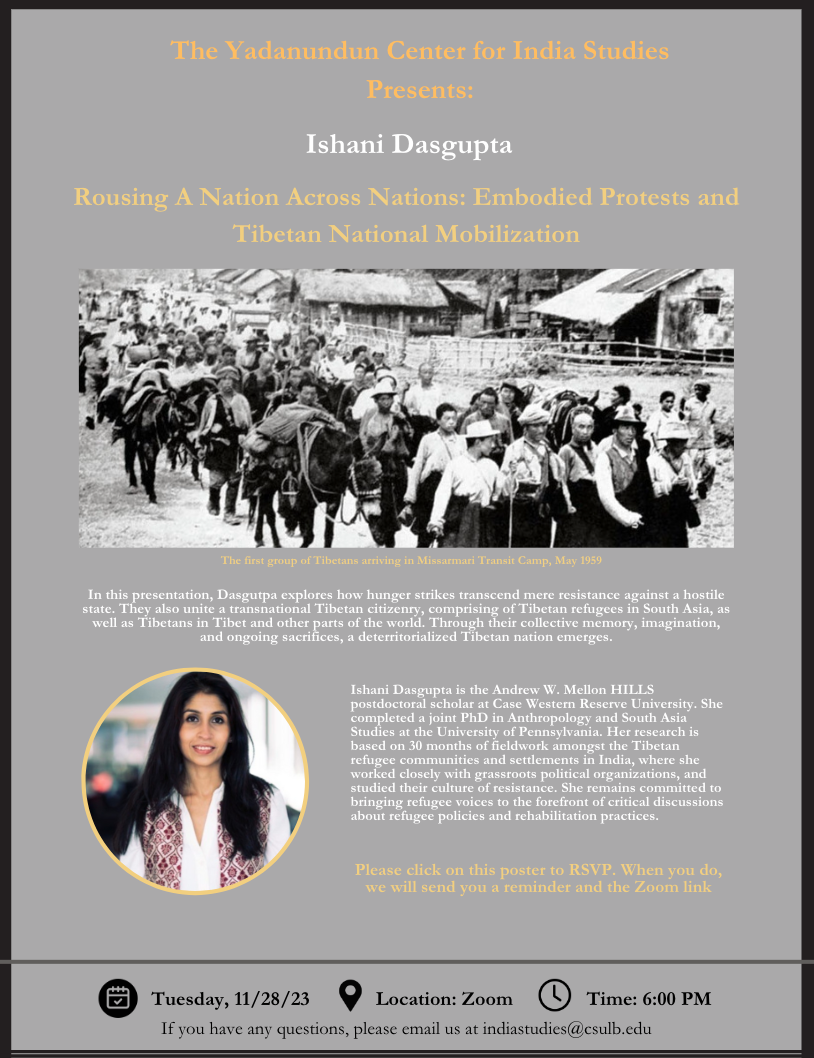
For individuals like Tsewang Dolma and Soepa Rinpoche, political action transcends mere resistance against a hostile state or a desperate plea to supranational bodies like the United Nations. It also serves the purpose of uniting a transnational Tibetan citizenry, comprising of Tibetan refugees in South Asia, as well as Tibetans in Tibet and other parts of the world. Through their collective memory, imagination, and ongoing sacrifices, a deterritorialized Tibetan nation emerges.
Join us on Tuesday, November 28 at 6:00 PM over Zoom where Ishani Dasgupta will share her research based on 30 months of fieldwork amongst the Tibetan refugee communities and settlements in India. She has worked closely with grassroots political organizations, and studied their culture of resistance. Her work has been supported by the Wenner-Gren Foundation and the American Institute of Indian Studies. She has presented her research widely, both in academic forums and in policy venues. She remains committed to bringing refugee voices to the forefront of critical discussions about refugee policies and rehabilitation practices.
Fighting Freedom Inc.: Imagining Individual Freedom Beyond Global Capitalism in New Indian Literature and Culture
Join us October 30th at 5:30 PM In the Antatol Center! Where Dr. Mangharam will draw on her newest work, which explores the ways in which lineages of liberation remain present in a wide range of texts in South Asia including the Dalit memoir, film, and the realist novel, works that offer fuller notions of autonomy and agency than those that appear in conventional imaginaries of freedom
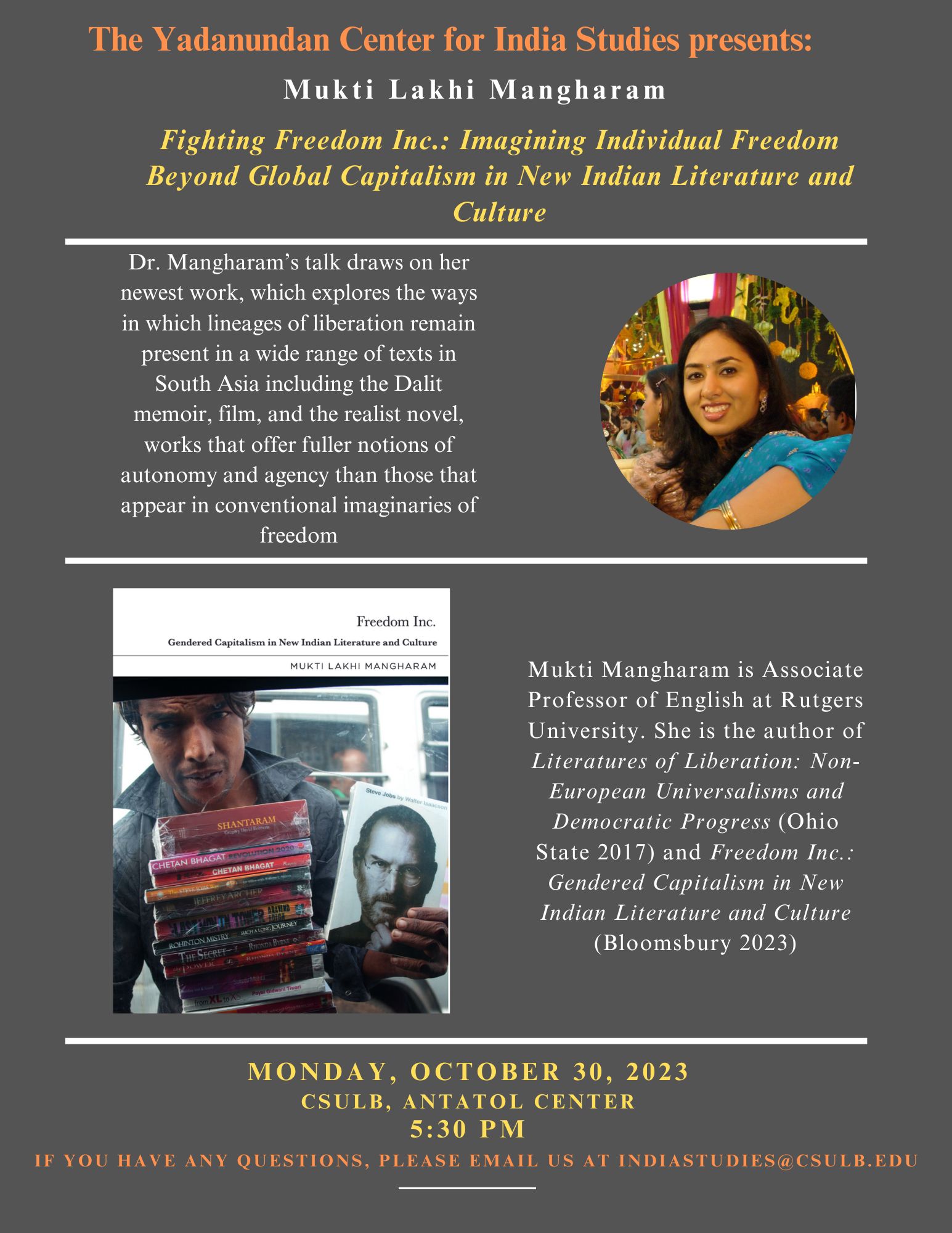
2023 Annual Solanki Lecture: In the Realm of Untamed Waters – Thoughts on the Deep Ecology of the Ganges Delta
Please see attached flyer for the Annual Solanki Lecture with Sudipta Sen on April 17.
Reception/Dinner will start at 6pm and lecture at 7pm.
Scan the RSVP code in the flyer to register for free.
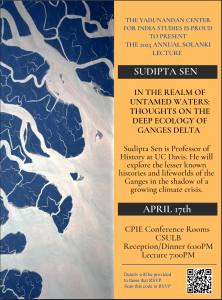
Reading Women, Translating Cultures—a discussion on Geetanjali Shree’s Tomb of Sand
The Yadunandan Center for India Studies is proud to present a talk by
Pravina Cooper and Jason Grunebaum :
“Reading Women, Translating Cultures—a discussion on Geetanjali Shree’s Tomb of Sand”
Jason Grunebaum teaches Hindi and literary translation at the University of Chicago. translations from Hindi include Uday Prakash’s The Girl with the Golden Parasol, The Walls of Delhi, and, with Ulrike Stark, Manzoor Ahtesham’s The Tale of the Missing Man. He also helped establish the Armory Square Prize for South Asian Literature in Translation, the first prize for literature in translation from South Asia.15).
The conversation will take place on Zoom on February 16th at 6:00 PM.
Click the poster to Join or the link below, see you there!
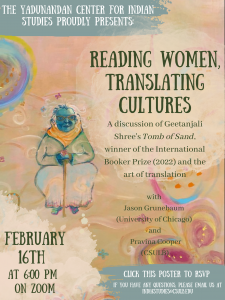
“At the Limits of Cure” A Lecture by Bharat Venkat
The Yadunandan Center for India Studies is proud to present a talk by Bharat Venkat from UCLA’s Institute for Society & Genetics and Department of History titled:
“At the Limits of Cure”
In 1950s Madras, an international team of researchers demonstrated that antibiotics were effective in treating tuberculosis. But just half a century later, reports out of Mumbai stoked fears about the spread of totally drug-resistant strains of the disease. Had the curable become incurable? Through an anthropological history of tuberculosis treatment in India, Dr. Venkat’s presentation will examine what it means to be cured, and what it means for a cure to come undone.
The conversation will take place at the Anatol Center on September 20th at 5:30PM.
To RSVP please click on the image below.
If you have any questions, please email us at indiacenter@csulb.edu.
If you post this event or flyer on another platform (or if the embedded link is not working) the link to the RSVP form is:
2022 Annual Solanki Lecture: Farhad Manjoo “Tech and the Burning World”
We are pleased to announce that we will be hosting this year’s annual Solanki Lecture in person on the CSULB Campus. The event will take place at the College of Professional & Continuing Education building on April 21st. There will be a reception (where dinner will be served) at 6:00 PM. The lecture and Q&A will begin 7:00 PM.
We will also be live-streaming the event for those who are unable to attend in person. Please use this link to view the event virtually: https://www.youtube.com/watch?v=3FKELVOrf0M
Farhad Manjoo, an opinion columnist at The New York Times, has been covering the Internet and the technology industry for two decades. He’ll talk about the ways digital technology is changing global societies.
3/24: A Talk with Tandi Madan – India’s Response to the Russia-Ukraine War
Tanvi Madan is a senior fellow in the Project on International Order and Strategy in the Foreign Policy program, and director of The India Project at the Brookings Institution in Washington, DC. Madan’s work explores India’s role in the world and its foreign policy, focusing in particular on India’s relations with China and the United States. She also researches the U.S. and India’s approaches in the Indo-Pacific, as well as the development of interest-based coalitions, especially the Australia-India-Japan-U.S. Quad.